
How to Improve Website Conversion Rate: 12 Proven Strategies
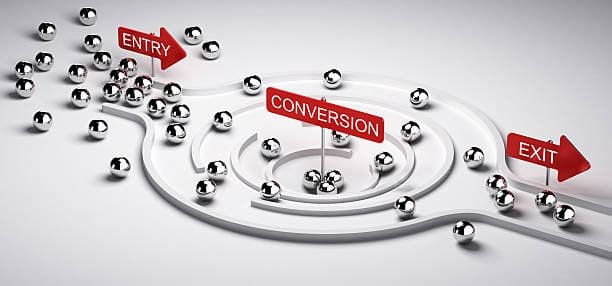
Imagine spending thousands of dollars to generate traffic to your website – and 97% of visitors not doing anything.
That’s the way it is for most businesses. Almost everyone who finds you online just disappears — the average website conversion rate across industries is only 2–3%.
The best news? You don’t always need more traffic to increase your revenue. You need to convert the traffic you already have better. That’s exactly what conversion rate optimization (CRO) is for.
In this guide, you’ll learn 12 actionable, proven strategies to improve your website conversion rate — backed by real data and used by top-performing brands to turn passive browsers into loyal, paying customers.
1. What Is Website Conversion Rate and Why Does It Matter?
A website conversion is when a visitor takes the desired action on your site. That action may be:
- Making a purchase
- Signing up for a newsletter
- Filling out a contact form
- Downloading a free resource
- Booking a demo or consultation
Your conversion rate is the percentage of visitors who follow through with that goal in a given period of time. It’s one of the most important KPIs in digital marketing because it directly measures the effectiveness of your website in converting interest into revenue, without having to spend more on ads.
Even a small increase in conversion rate can make a dramatic difference to your bottom line. Let’s say you get 10,000 visitors a month and your current conversion rate is 2%. You’re getting 200 conversions. If you can bump that rate up to just 4%, your conversions double to 400 – without spending a single rupee on traffic.
2. How to Calculate Your Conversion Rate?
The formula is straightforward:
Conversion Rate (%) = (Number of Conversions ÷ Total Visitors) × 100
For example: if your website received 5,000 visitors last month and 200 of them made a purchase, your conversion rate is (200 ÷ 5,000) × 100 = 4%.
Track this metric regularly using tools like Google Analytics 4, Hotjar, or your e-commerce platform’s built-in analytics dashboard.
3. 12 Proven Strategies to Improve Website Conversion Rate
Strategy 1: Speed Up Your Website
One of the biggest factors affecting conversions is page speed. Studies have shown that a 1 second delay in loading a website leads to a 7% drop in conversions. Google uses page speed as a ranking factor so a slow site will hurt your SEO and your revenue.
Fast Wins to Increase Page Speed:
- Webp image converter and compressor
- Enable browser caching & lazy loading
- Compress CSS, JavaScript and HTML files
- Utilize a Content Delivery Network (CDN)
- Switch to fast, reliable hosting
Audit your current load times and look for bottlenecks with Google PageSpeed Insights or GTmetrix.
Strategy 2: Write Compelling, Benefit-Focused Headlines
Your headline is the first thing a visitor will read. If it doesn’t scream value to them right away, they will be out of there in seconds. The top converting headlines are clear, specific and benefit-focused – they answer the visitor’s unspoken question: “What’s in it for me?”
Weak h1: “Welcome to Our Website”
Strong h2: “Increase Your Sales by 40% Using Our AI-Powered Marketing Platform”
For your headlines, use the 4 U’s – Useful, Urgent, Unique, and Ultra-specific.
Strategy 3: Optimize Your Calls to Action (CTAs)
Your call to action (CTA) is the differentiator between a bounce and a conversion. One of the most common conversion killers is a poorly designed or vague CTA.
Best practices for optimizing CTAs:
- Use active, first person language (e.g. “Start My Free Trial” instead of “Sign Up”)
- Make the button stand out visually – High contrast color, big enough to tap on mobile
- Place CTAs above the fold AND at logical decision making points throughout the page
- Generate urgency without lying (e.g. “Get 20% Off — Today Only”)
- Get rid of competing CTAs that distract from the main goal
Strategy 4: Build Trust with Social Proof
People trust people. Visitors naturally seek reassurance that other people have had a good experience with your brand before they make a decision. This is a psychological phenomenon called social proof, and it is one of the most powerful conversion levers available.
Good elements of social proof are:
- Customer reviews and star ratings (particularly close to CTAs)
- Case studies with real, measurable results
- Trust badges (SSL certificates, payment logos, industry certifications)
- B2B client logos
- Real-time activity notifications (e.g. “23 people are viewing this right now”)
- Testimonials with photo, name, and job title
Strategy 5: Simplify Your Forms
Each additional field on a form can be a drop off. Studies have been conducted for years that have proven that shorter forms convert at higher rates. Too early and too much information is a loss of leads that have been paid to capture.
Form optimization tips:
- At this point, only ask for information that is helpful.
- Fill out multi-step forms for complicated processes, they are not as intimidating.
- Add validation in-line so that users are aware of error immediately.
- Use cookies and/or saved data to pre-fill fields when possible.
- To alleviate concerns about data, add a privacy note near submit button.
Strategy 6: Run A/B Tests Consistently
A/B testing (or split testing) is a method that involves displaying two versions of a page element to different parts of your audience to see which one works best. It eliminates the subjectivity and enables data to guide optimization decisions.
Things to consider for A/B testing:
- Copy for headlines and subheadings.
- The color, size and text of the CTA button.
- Branded pictures versus product videos.
- The length of the form and the order of the fields.
- The price to be displayed and its format.
- The layout and navigation of a webpage.
Test using tools such as Google Optimize, VWO or Optimizely. Always change only one variable at a time to get clear results and conduct tests for enough length of time to achieve statistical significance.
Strategy 7: Optimize Your Landing Pages
The goal of a landing page is to convert a visitor. A high converting landing page will differ from a general web page because it will be distraction free, remove navigation menus, and concentrate on just one offer and one CTA.
These are some of the main considerations for optimizing your landing pages:
- Use a landing page which contains the same message as the ad or link to the page (message match)
- Make copy concise, scan-able and benefit-driven
- Use bullet points to emphasis main features and outcome,
- Have a prominent CTA above the fold.
- Take away main navigation to stop people from leaving.
- Include urgency features – countdown timers, limited availability messaging
8: Improve Mobile User Experience
Over 60% of all web traffic is now via mobile device. When you don’t fully optimize your website for mobile, you’re losing conversions day after day. Google’s mobile-first indexing also means that if your mobile experience isn’t up to scratch, it will negatively impact your search results.
Mobile UX optimization checklist:
- Create a responsive design that works for all resolution sizes
- Make buttons and links easy to touch with your thumb (at least 44×44 pixel)
- Reduce the number of popup windows that prevent content from displaying on smaller devices
- Check out test flows and forms in actual mobile devices.
- Make use of Accelerated Mobile Pages (AMP) on critical landing pages.
Strategy 9: Reduce Cart Abandonment
Cart abandonment is one of the top conversion rate killers for ecommerce businesses. The average cart abandonment rate is around 70% – that is, 7 out of 10 shoppers leave without buying any items.
Tactics to reduce cart abandonment:
- Provide progress indicators as customers go through checkout
- Have a guest checkout as opposed to making guests create an account.
- Display the total cost (including shipping and taxes) early on in the process
- Include various payment methods such as credit card, PayPal, Buy Now Pay Later.
- If someone leaves a cart without making a purchase, email them about it within 1 hour.
- Implement exit-intent pop-ups offering a discount code on the cart page. Create exit-intent pop-ups with a discount code on the cart page.
Strategy 10: Use Live Chat and AI Chatbots
A lot of visitors leave a website because they are unable to get the answer to their certain question. This friction can be solved in real-time by live chat and AI-powered chatbots, before it becomes a reason to abandon the website. Overall, websites that feature live chat have been known to boost conversion rates by 10–40%, especially in high-consideration purchases. The potential impact on your bottom line is huge even if you have a simple chatbot answering FAQs, qualifying leads, or scheduling demos.
Strategy 11: Personalize the User Experience
Not everybody who visits is the same person — why present them with the same experience? Web personalization adapts the page content, content offers, ads, etc. displayed to a visitor according to his/her actions, location, device, or buying phase.
Personalization strategies:
- Offer different offers to return visitors than to first-time visitors.
- Set homepage banners according to traffic source (such as a certain ad campaign)
- Show recently viewed products/content
- Taikoo offers you geo targeting to display location-specific pricing or promotions.
- Suggest recommendations from previous browsing patterns
There are also tools available, such as Segment, Optimizely, or HubSpot, which can help put personalization into practice at scale.
Strategy 12: Use Exit-Intent Popups
When a user starts pointing towards the close button or back arrow of the browser, an exit-intent popup appears. It provides you with one final chance to turn a visitor into a customer, and they are very effective, if used correctly.
To help you understand the best practices for using exit-intent popups, here are some key points to note:
- Provide something of value: a discount code, a free resource, or a guide.
- Limit copy and keep the design clean.
- Make a strong headline that focuses on the benefit (e.g., Wait — Here’s 15% Off Your First Order)?
- Add a clearly visible CTA button and a simple close button.
- Avoid showing the pop-up on every page — do it strategically on pages high in bounce rates.
4. How to Track and Measure CRO Success?
Without measurement, implementing CRO is driving blind. To know what’s working, clear benchmarks and metrics are required.
Some key CRO metrics to keep track of:
- This is your core north-star metric.
- Bounce Rate — If it has a high bounce rate, it may mean the site is not relevant or that the site loads too slowly.
- Average Session Duration — Do your visitors interact with your content?
- Which buttons on CTAs get the most clicks (CTR)?
- For eCommerce sites, the Cart Abandonment Rate is a crucial metric.
- The Cart Abandonment Rate is a key metric for eCommerce sites.
- See how users interact using Heatmaps or Session Recordings, via Hotjar or Microsoft Clarity.
Install Google Analytics 4 Goals to monitor micro and macro conversions, such as newsletter sign-ups, video views and purchases.
Conclusion
Increasing website conversion rate is not about manipulation or playing tricks. It is about decreasing any friction, gaining more trust, and making it easier for your potential customer to take the desired action.
Always start with the biggest impact first: improve the load speed, refine the headlines, and optimize your CTAs. Later add more sophisticated techniques, such as personalization, A/B tests, and exit intent pop-ups.
Just a 1-2% increase in conversion rate means a significant improvement in revenue from all the traffic you already have paid for. Not necessarily the companies that have the most traffic grow fast — it is those who utilize it in the best way.
FAQs
What makes for a good conversion rate on the website?
Depending on the industry, there are different conversion rate benchmarks. The average website will usually have a 2-5% conversion rate. However, ecommerce websites tend to have 1-3%, and lead generation pages can have 5-10%. In niche industries, high-performance pages can get even 10-20+% through CRO.
How long does it take to get conversion rate optimization results?
Some changes such as optimizing the load speed or refining the CTA wording can produce results within just a few days. It takes 2-4 weeks to conduct a reliable A/B test. Larger-scale changes in UX can take 1-3 months to fully evaluate.
What is the difference between SEO and CRO?
SEO (Search Engine Optimization) is about getting as much traffic to your website via organic search as possible. CRO is about converting that traffic into leads/customers. Both strategies should be used together because SEO drives traffic, and CRO converts it.
What tools do I need for conversion rate optimization?
The main CRO tools are the following: Google Analytics 4 (for tracking), Hotjar (heatmaps and session recording), A/B testing tools (Google Optimize or VWO), landing page builder (Unbounce or Instapage), live chat service (Intercom or Tidio).